By Dan Larson ·
If you have lived in Weatherford through a single spring, you know what Parker County clay soil does when it rains. Water pools in the backyard, collects against the home perimeter, turns low spots into temporary ponds, and takes days to drain. During dry spells the opposite happens: the clay shrinks, cracks open, and the ground pulls away from slabs and retaining walls. This swell-shrink cycle is the defining characteristic of the Walnut Clay and Eagle Ford Shale formations that underlie most of the Weatherford area, and it creates drainage challenges that homeowners in sandier regions never encounter.
The good news is that these problems are solvable. The right combination of drainage solutions and grading corrections can eliminate standing water, protect your home, and turn problem areas into functional landscape space. The key is understanding which drainage methods work in our specific soil conditions and which ones waste money because they are designed for different geology.
Why Weatherford Yards Have Drainage Problems
Clay soil is the root cause of nearly every residential drainage issue in Parker County. Unlike sandy or loamy soils that allow water to percolate downward quickly, clay has extremely low permeability. When rain hits clay soil, the top layer absorbs water and swells, creating an even more impermeable barrier that prevents the water below from draining. The result is surface pooling that can persist for days after a storm.
Three factors make drainage problems worse in specific areas of your yard:
- Negative grading. The ground slopes toward the house rather than away from it. This is surprisingly common in Weatherford, either because the original grading was poor or because years of soil settling and landscaping changes have altered the grade. Water flows downhill, and if downhill means toward your home, you have a structural problem in addition to a landscape problem.
- Construction compaction. During home construction, heavy equipment compacts the clay to a near-impermeable layer. Builders often bring in a thin layer of topsoil for the final grade, but underneath that topsoil the clay is packed so tightly that water cannot penetrate it. Newly built homes in developments along FM 920, Garner Road, and the Aledo corridor frequently have the worst drainage because the native soil has been severely compacted during the building process.
- Downspout discharge. Roof runoff concentrated through downspouts dumps a large volume of water at a single point against the home perimeter. Without extensions, splash blocks, or underground discharge lines, this concentrated flow erodes the soil beside the home perimeter and saturates the clay in exactly the area where you need it to stay dry.
French Drains: The Workhorse Solution
A French drain is a trench filled with gravel and a perforated pipe that collects subsurface water and routes it to a discharge point away from the problem area. It is the most common and most effective drainage solution for residential properties in Parker County because it addresses the core problem: water trapped in clay soil with nowhere to go.
A properly installed French drain in Weatherford clay requires deeper excavation than the generic guides suggest. Most online sources recommend a 12-inch trench. In our clay, we dig 18 to 24 inches deep and line the trench with filter fabric before adding 6 inches of clean gravel, the perforated pipe, and then filling to grade with more gravel. The filter fabric is essential in clay soil because without it, fine clay particles migrate into the gravel over time and clog the drain. This failure mode is the single most common reason French drains stop working in North Texas, and it is completely preventable with proper installation.
The discharge end of the French drain needs to outlet to a point where the water can leave your property without creating problems for neighbors. Options include a pop-up emitter at a low point in the yard, a connection to the street gutter if permitted, or a dry well filled with gravel that slowly releases the water into the surrounding soil. We assess the best discharge option during the initial site visit because every property's topography and relationship to neighboring lots is different.
Catch Basins and Surface Drains
Where water collects in a visible low spot on the surface, a catch basin provides a direct collection point. The basin is a recessed box with a grated top that sits at the lowest point of the problem area. Water flows into the grate, drops into the basin, and is carried away through a solid (non-perforated) underground pipe to a discharge point.
Catch basins work well for specific, localized problems: the corner of the patio where water collects, the base of a slope where runoff concentrates, or the bottom of a swale between two houses. They are fast to install and immediately effective because they address surface water directly rather than relying on subsurface percolation.
We often combine catch basins with French drains in a single drainage system. The catch basins handle the visible surface water while the French drains address the subsurface saturation that causes the clay to stay waterlogged even after the surface appears dry. This combination approach solves the problem at both levels simultaneously.
Regrading: Fixing the Slope
No drain can compensate for a yard that is graded incorrectly. If the ground slopes toward the home perimeter rather than away from it, the first step in any drainage plan is regrading to establish positive drainage away from the house. The general rule is a minimum of 6 inches of fall over the first 10 feet from the home perimeter, which translates to roughly a 5 percent slope.
In Weatherford's clay soil, regrading often needs to be done in conjunction with soil amendment. Simply moving the existing clay into a new slope does not improve its permeability. Adding expanded shale, comite, or a sand-compost blend to the regraded area improves drainage in the top 6 to 8 inches of soil, which is enough to prevent most surface pooling issues. This amended layer acts as a buffer that absorbs the first inch or two of rainfall before the water reaches the impermeable clay below.
Regrading is most commonly needed around slabs, in side yards that serve as the drainage path between the front and back of the property, and in areas where patios, decks, or outbuildings have altered the original grade. We use a laser level to map the existing grade before any work begins, which allows us to calculate exactly how much soil needs to move and where.
Dry Creek Beds: Form and Function
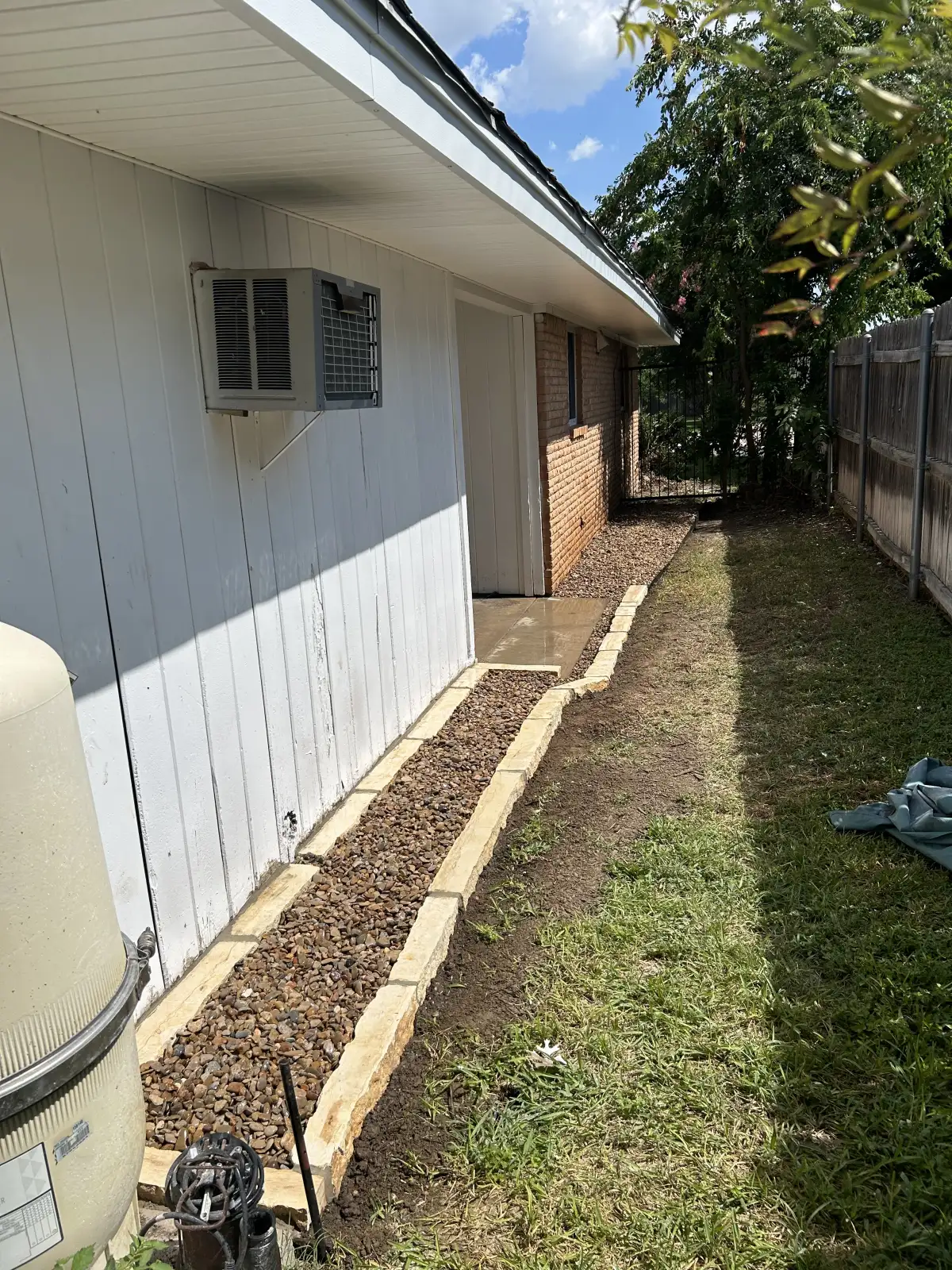
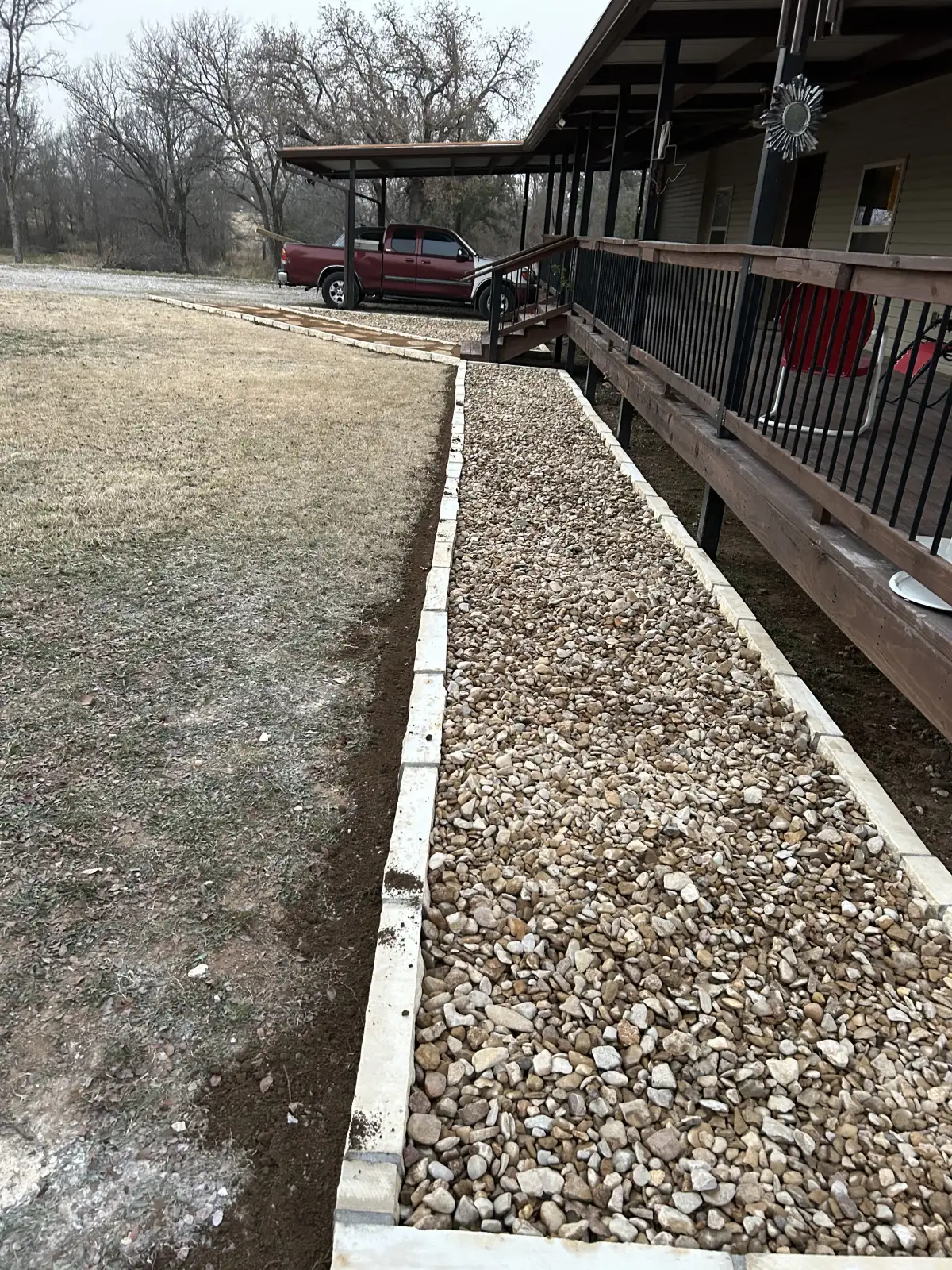
A dry creek bed is a shallow, rock-lined channel designed to carry water across your property during rain events and look like a natural landscape feature when dry. For properties where the drainage path crosses a visible area of the yard, a dry creek bed provides the same function as an underground pipe but adds aesthetic value rather than requiring everything to be buried and invisible.
In Parker County, dry creek beds work particularly well on sloped properties where water naturally flows from a high point to a low point. Lining the creek with river rock, limestone boulders, and native stone creates a channel that manages even heavy flows without erosion, and the rock can be sized and arranged to slow the water flow, reducing velocity and allowing more absorption along the path.
We often integrate dry creek beds with the surrounding landscape design, planting native grasses and moisture-tolerant perennials along the banks to create a naturalistic composition that looks intentional rather than utilitarian. When designed well, a dry creek bed becomes a focal point of the landscape rather than a reminder that the property has drainage issues.
Downspout Management
Roof runoff is the single largest source of concentrated water on a residential property. A 2,000-square-foot roof generates roughly 1,200 gallons of water from a single inch of rainfall. If that water is dumped directly at the home perimeter through unmanaged downspouts, it saturates the clay in the most structurally critical area of the property.
The simplest fix is downspout extensions that carry roof runoff at least 6 to 10 feet away from the home perimeter. Surface extensions work but are visually intrusive and create tripping hazards. Underground downspout discharge lines, which connect the downspout to a buried solid pipe that outlets at a pop-up emitter in the yard, provide the same function without the surface obstruction. We install underground downspout lines as part of most comprehensive drainage projects, and they can also be added as a standalone improvement for homeowners who are not yet ready for a full drainage system.
What Happens If You Ignore Drainage Problems
Drainage issues in Weatherford's clay soil get worse over time, not better. Standing water against the home perimeter causes the clay to expand, putting lateral pressure on the perimeter walls. Over years, this pressure causes cracks, bowing, and shifting that are extremely expensive to repair. Structural repair in North Texas commonly runs $5,000 to $25,000 or more depending on the extent of the damage.
Beyond the home perimeter, saturated clay kills plant roots by displacing the oxygen in the soil that roots need to function. Turf, shrubs, and trees in poorly drained areas develop shallow root systems, become susceptible to disease, and often decline over several seasons in a pattern that looks like a fertility problem but is actually a drainage problem. Addressing the drainage first is essential before investing in new plantings or sod.
Saturated clay also accelerates the failure of hardscape features. Retaining walls that hold back saturated clay experience hydrostatic pressure far beyond their design load, which can cause leaning, cracking, and eventual collapse. Patios and pathways on saturated clay heave and settle unevenly as the soil goes through its swell-shrink cycles. Every hardscape investment on the property benefits from proper drainage beneath and around it.
Frequently Asked Questions
How much does a French drain cost in Weatherford TX?
French drain installation in Weatherford typically costs $25 to $50 per linear foot, including excavation, gravel, perforated pipe, and landscape fabric. A typical residential French drain runs 50 to 150 feet, putting the total project cost between $1,250 and $7,500 depending on depth, length, and soil conditions. Clay soil in Parker County requires deeper excavation and more gravel than sandy soil, which pushes costs toward the higher end of this range.
Why does my yard hold standing water after rain?
Parker County sits on Walnut Clay and Eagle Ford Shale formations that drain extremely slowly. When rain falls faster than the clay can absorb it, water pools on the surface. Low spots in the yard, compacted soil from construction, and negative grading that directs water toward the house rather than away from it all contribute to standing water. In most cases, the solution involves some combination of regrading, French drains, and catch basins to give the water a path off the property.
Can you install drainage without tearing up the whole yard?
In many cases, yes. French drains and catch basin lines require a trench that is typically 6 to 12 inches wide, which disturbs a relatively narrow strip of lawn. Sod or seed can be laid over the trench within a day of completion. Surface regrading is more disruptive but still limited to the areas that need correction. We plan drainage routes to minimize landscape disruption and restore disturbed areas as part of every installation.
Do I need a permit for drainage work in Weatherford?
Most residential drainage projects in Weatherford do not require a building permit, provided the work does not alter the natural drainage pattern in a way that affects neighboring properties or public right-of-way. However, if the project involves connecting to the city storm sewer system, altering a creek or waterway, or working within a floodplain, permits may be required. We assess permit requirements during the initial consultation and handle any necessary filings.